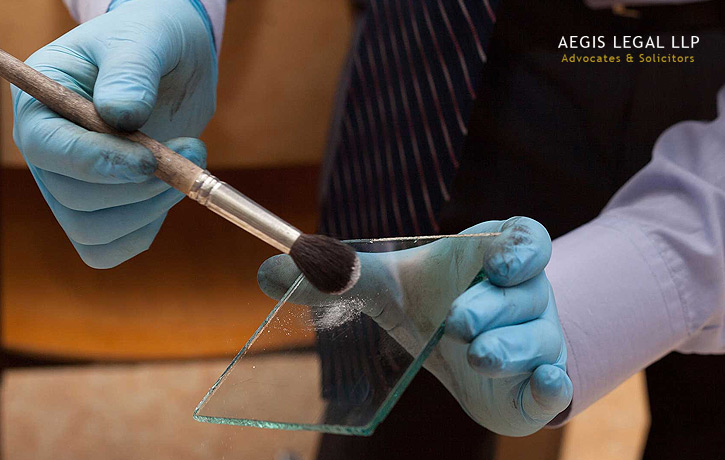
Can Forensic Examination be done of a photocopy document where The Original Document is Lost or Misplaced?
✍ Article By Ashok K Singh & Samridhi Singh, (Advocates, Supreme Court of India)
Date : 4/11/2025
The primary objective of forensic examination is to establish facts and reconstruct the truth of an event through the scientific analysis of evidence. Expert opinion should always be based on original documents, as examination of photocopy documents are not conclusive and remains doubtful.
“Forensic” literally means “pertaining to Court of Law”. Forensics means “Science pertaining to Court of Law”. The word is now synonymous for scientific methods and techniques used to evaluate evidentiary clues, extract information from them, rationalize the information and draw conclusions to assist the courts in the dissemination of justice. Forensics helps criminal and civil investigations in providing answers to various questions which come up to link the criminal with the victim, with the scene, with instruments of crime, the vehicle used to commit the crime, with the modus operandi and to verify the versions and to provide leads.
The primary objective of forensic examination is to establish facts and reconstruct the truth of an event through the scientific analysis of evidence. This involves identifying, preserving, analyzing, and reporting evidence to assist in criminal investigations, legal proceedings, and understanding the circumstances of a crime.
Forensic examination of a photocopied document involves analyzing the physical and chemical characteristics of the copy to determine its authenticity and source. This includes examining the toner, paper, and any defects or irregularities present in the copy. The goal is to identify if the photocopy is a true representation of an original document or if it has been altered or forged.
The admissibility of photocopy document is a critical consideration in context to sending the documents to the Forensic Science Laboratory. It is not advisable for experts to take photograph of photocopies and base their opinion on such photocopies. Expert should always base his opinion on original documents. When an expert forms his opinion on the basis of photocopies.
There are many challenges as well which are being faced by the handwriting experts when it comes to the examination of the photocopy documents. The forensic document experts conduct scientific examination, comparison and analysis of photocopied document in order to ascertain the authorship of handwritten text content as well as signatures, to established genuineness or non-genuineness, or to reveals the additions, alterations, deletions in cases of forgery. In cases, where the photocopied document is only required to examine, in absence of original document it becomes more challenging to conclude an opinion based on limited data. There is certain limitation in examination of photocopied documents. Even every machine has its own limitation in reproducing the original documents. Hence it is very important to understand the photocopying process of different kinds of machine. To understand the detail characteristics of photocopied document of different machine it is necessary to make comparison between photocopied documents and original ones in detail, so that forensic document expert can able to study the limitations of various photocopying machines which would be definitely helpful for them encountering the actual cases related with photocopied document examination.
In order to express opinion on photocopied document, it is worth to mention here that any expert opinion is based on collection of all relevant data and records available, systematically and scientifically during the process of examination of concerned documents in preparing observation notes which is also useful for the presentation of effective court testimony. All the handwriting features are not exactly present in the photocopied documents. When the photocopied signatures are compared with the known original standard, the accurate judgment regarding line quality, ink morphology, ink gooping, hesitation, tremor, etc. is sometimes not possible to conclude. Expressing the opinion on poor quality of reproduced document is not justified. Hence, in such problematic circumstances, it is very difficult to fix the authorship of signature or handwriting in absence of original. The handwriting features like pen lift, pen skipping, pen pressure, pen patching and the most important thing is that the line quality of the stroke cannot be examine by the photocopied document. In examination of photocopied documents, the queries are also asked to find out the generation of particular photocopies. Expansion of strokes and baseline printing, discontinuity of stroke in letter formation, loss in smoothness of edge in executing the strokes in photocopied documents are useful in determining the generation of photocopied but to ascertain the authorship of the writer is difficult to find due to lack of evaluation of adequate and accurate handwriting features.
Apart from these problems, examination of watermark is also difficult which do not come in photocopied document. In case of traced forgery, indented outline do not come in photocopied document, so it is also very difficult to examine cases related with traced forgery by photocopied document. Traced forgery is made by tracing over an authentic signature in manner that guideline or indented outline of the signature on the document can be forged. The forger then retraces the indentation with any writing instrument. Signature and handwriting examination and comparison problems from photocopies allow examination of various handwriting characteristics, individual letter formation, connection and combination of letters, individual position of i-dot and t-crossing etc. but limit the skill of forensic document examiner to evaluate evidence such as speed of execution of strokes, lifts of the writing instruments, retouching of stoke and other important evidence.
The forensic document experts sometimes hesitate to express technical reports and opinions on the authorship of photocopied signatures and handwriting due to the reason that all details of handwriting characteristic features including execution of strokes while making letters, there connection and combination in original signatures and handwritings are not possible to reproduced exactly same in photocopied documents, thus, finally the original documents are required to confirm the detailed study of execution of strokes for the scientific examination and opinion.
There is no legal sanctity of a photocopy document and cannot be examined. Recently, the Hon’ble Delhi Court has also affirmed the above-said view and question reliability of opinion based on photocopy documents. In the matter of Narender Kumar vs The Mgmt. Of M/S Maman Chand R on 31January, 2023 [MANU/DE/0625/2023] the Hon’ble High Court of Delhi has observed that.
“33. it can be deduced that the report of the handwriting expert remains questionable and unreliable since the same is based on the examination carried upon xerox documents. This Court holds the expert opinion/report as an unreliable source of comparison and hereby attaches no evidentiary value to the same in the present dispute.”
That in the case of Gunashekar N vs Station House Officer on 10 March, 2023, the Hon’ble Karnataka High Court held that,
“48. The law is clear that the opinion of handwriting expert is relevant but not conclusive. It is a fragile type of evidence. It is only corroborative evidence. It's probative value is that only on the basis of expert opinion no conclusion can be drawn if there is no other supportive evidence. It is to be accepted with good amount of circumspection.”
Forensic science laboratories can provide expert opinions based on photocopies, particularly when the original documents are not available, as long as the photocopies are verified for authenticity and accuracy.
The forensic examination of photocopied document requires great deal of understanding, education, knowledge, training and skill. The forensic document experts who practice within this profession often use their technical skill and wisdom for concluding opinion. Opinion given by the expert either definite or qualified based on examination of photocopied document is one of the concluding parts of the total evidence collected from such document. The original document is always preferred by the forensic document experts to give opinion regarding the authorship of the written documents.